
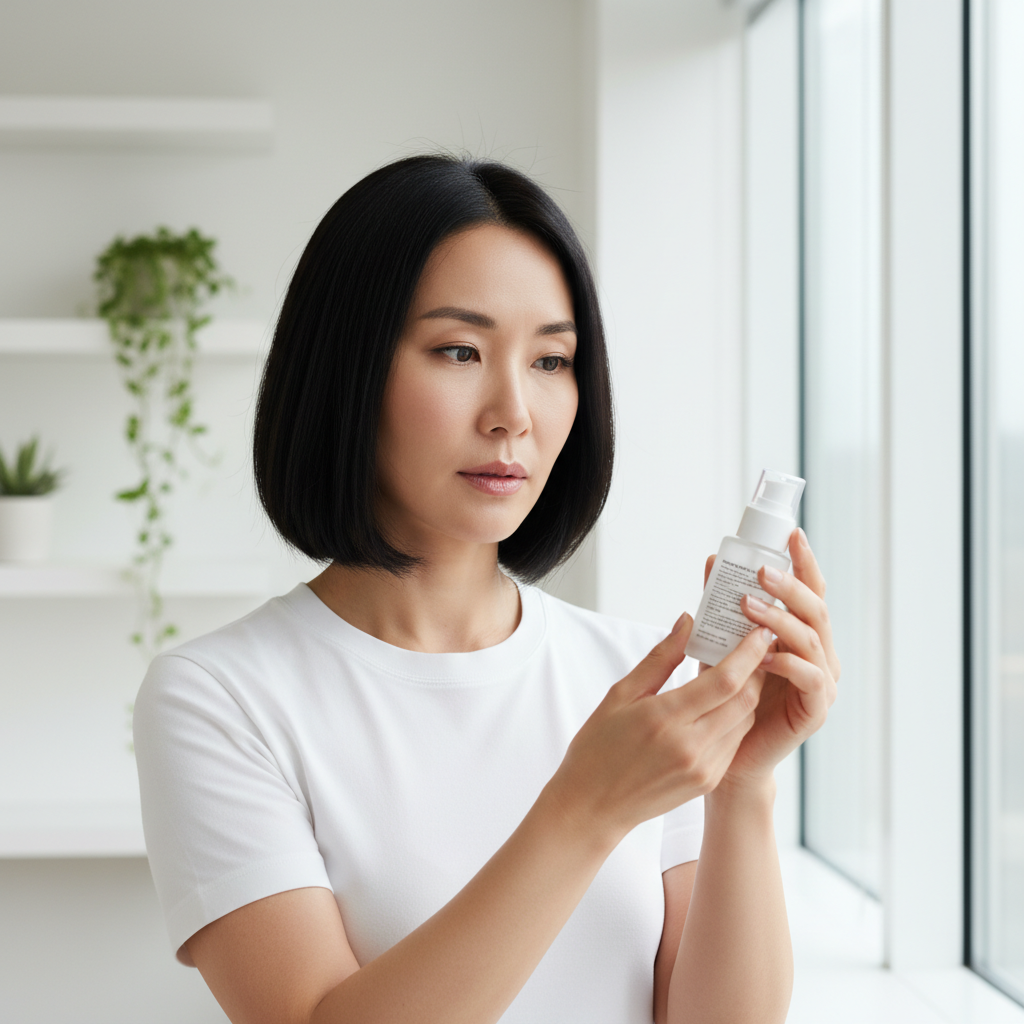
I used to spend twenty minutes squinting at the back of a moisturizer in the middle of a store aisle, phone in one hand, EWG Skin Deep app in the other, Googling "is phenoxyethanol bad" while someone waited for me to move my cart. That was before I built a system.
Now I can scan a label in about sixty seconds and know whether something earns a place in my bathroom or goes back on the shelf. The system works because ingredient labels follow predictable patterns once you know what to look for.
Start at the Top, Stop at the Fifth Ingredient
Ingredients are listed in descending order by concentration. The first five are where the real product lives. If your "vitamin C serum" has water, glycerin, and then seventeen filler ingredients before you find ascorbic acid somewhere near the bottom, you are not buying a vitamin C serum. You are buying a very expensive water.
The top five tell you what the formula actually does. If they're a parade of silicones and alcohols, the product might feel good on skin immediately but do little underneath. If they're actives with clinical backing, things like niacinamide, retinol, or hyaluronic acid, you know something real is happening.
The Short List of Things I Avoid
I don't try to memorize every problematic chemical. That path leads to label paralysis. Instead, I keep a short working list of the ingredients with the clearest research concerns.
Fragrance (also listed as "parfum") is the wildcard term that can hide hundreds of undisclosed chemicals, some of which are known sensitizers and potential endocrine disruptors. A product can be marketed as "natural" and still contain fragrance blends. I skip anything with it in the first half of the label.
Parabens, specifically methylparaben, propylparaben, and butylparaben, show up as preservatives in a huge range of conventional products. The research is still contested, but when comparable paraben-free formulas exist at the same price point, the choice is easy.
Sodium lauryl sulfate is a surfactant common in cleansers and shampoos. It is effective but strips the skin barrier more aggressively than alternatives like sodium cocoyl isethionate or coco-betaine. If you have sensitive or reactive skin, this one matters.
Oxybenzone in sunscreens shows coral reef toxicity and has been found in human blood and breast milk in studies. I switched to mineral filters, zinc oxide and titanium dioxide, years ago and have not looked back.
I do not demand perfection. If an otherwise excellent product has one borderline ingredient at the very end of the list (meaning trace concentration), I weigh it differently than if that ingredient appears in position three.
The Greenwashing Tell
The phrase "infused with" is almost always a sign to look closer. "Infused with botanical extracts" means those botanicals are in there, somewhere, in some amount. They might be the eighth ingredient or the twenty-eighth. The marketing front sells the dream; the ingredient label tells the truth.
Same with "free from" lists. A product marketing itself as free from parabens, sulfates, and phthalates while containing fragrance, synthetic dyes, and PEGs is not a clean product. It is a product that has learned which words to use.
Where I Actually Shop
Once you build a working label literacy, finding clean products gets much faster. I do most of my supplement and beauty shopping through iHerb because their search filters allow you to sort by formulation type and they carry brands that meet EWG certification, NSF certification, or USDA Organic standards, depending on what you are looking for. The selection of clean actives, vitamin C formulations, and fragrance-free basics is the best I have found at non-boutique prices.
The sixty-second scan works anywhere, though. Once you have your short list of avoided ingredients memorized, any label becomes readable in the time it takes to wait in line at checkout.
A Habit Worth Building
Reading labels feels tedious until it becomes automatic. After about two months, you stop seeing a wall of unpronounceable words and start seeing the actual product. The intimidating part is the learning curve, not the skill itself.
The rule I keep coming back to: if you cannot find the active ingredient in the top third of the label, the product is selling you marketing, not results.
We recommend products we believe in. If you make a purchase through a link on our site like the one for iHerb, we may earn a commission at no extra cost to you.